
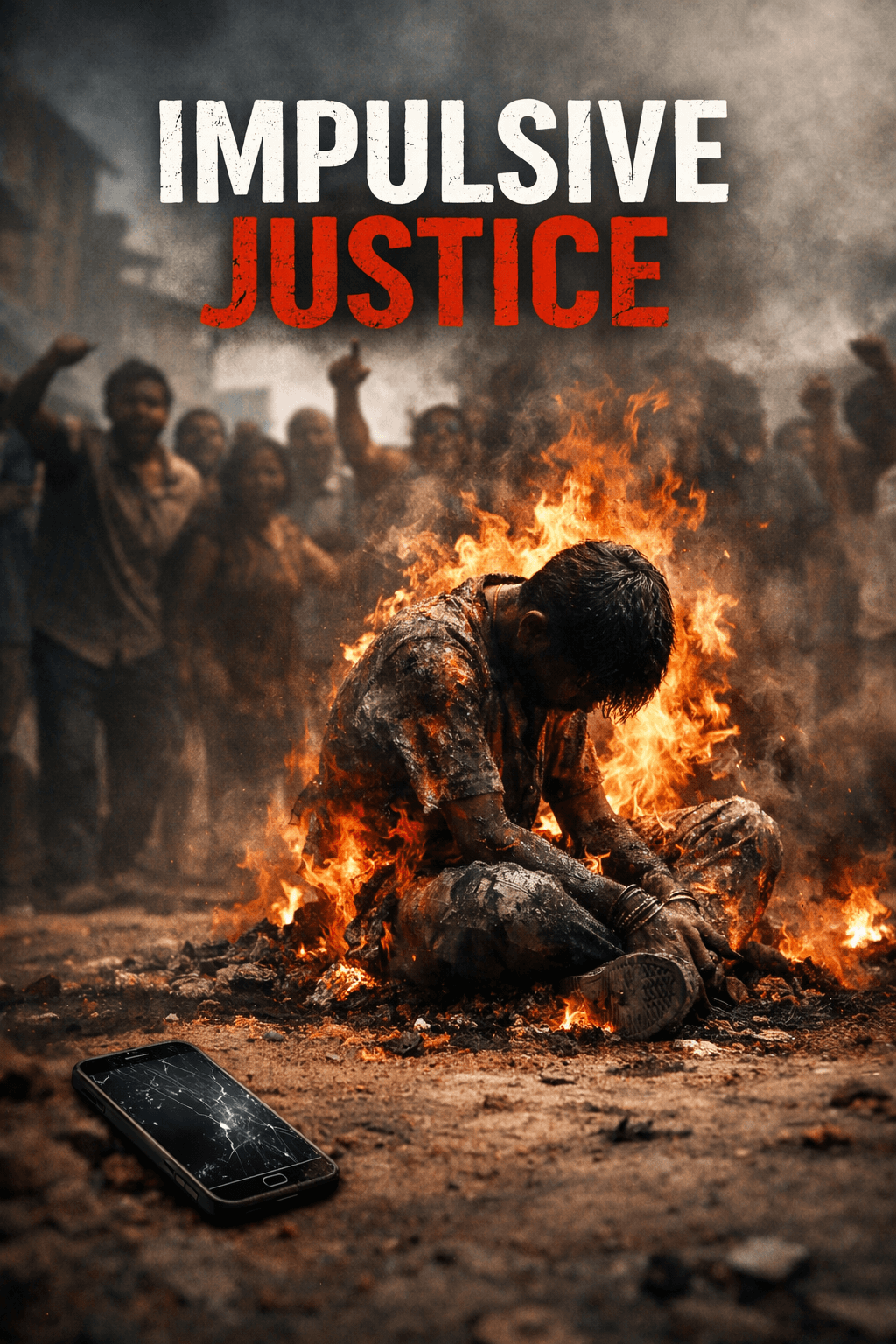
I was scrolling through Facebook like we all do — casually, absent-mindedly — when I came across a story that stopped me cold.
A young man named Elvis is dead.
Not after a long illness.
Not after committing a crime.
Not after a trial.
He died in the middle of a normal day.
On the busy streets of Nairobi, two ladies suddenly grabbed his phone and began screaming, “Mwizi! Mwizi!” — “Thief! Thief!”
That was all it took.
In seconds, a crowd formed. Not to investigate. Not to ask questions. Not to understand.
To react.
Voices grew louder. Hands began pushing. Fists started flying. Nobody paused to verify. Nobody asked what had actually happened. Nobody cared that this could be a misunderstanding.
He was already guilty.
Fuel was brought.
The crowd did not hesitate.
They set him on fire.
And they watched him burn.
The same women who had snatched his phone and triggered the chaos disappeared once the situation spiraled beyond control. They walked away alive. Elvis did not.
Just like that, a young man who woke up that morning with plans, dreams, responsibilities, maybe even someone waiting for him at home — was reduced to ashes in the name of instant justice.
No courtroom.
No evidence.
No defense.
Just impulse.
And the crowd went home.
Meanwhile, a family somewhere received the worst phone call imaginable. A mother lost her son. A father lost his pride. Siblings lost their brother. Maybe a partner lost her future. A home that was once whole is now permanently fractured.
And for what?
Because we have become a society that reacts before it thinks.
Because shouting is louder than truth.
Because accusation now equals guilt.
There is something deeply disturbing about how quickly we are willing to destroy a life. We live in an age of instant reactions — instant comments, instant outrage, instant judgment. Social media has trained us to respond, not reflect. To assume, not investigate. To react, not reason.
Mob justice is no longer shocking. It is almost expected.
And beneath this tragedy lies an uncomfortable question:
Was Elvis already condemned the moment he was identified as a man?
In that moment, he was not seen as a person. He was seen as a stereotype. A suspect. A perpetrator by default. The women were automatically believed. He was automatically guilty.
Nobody cared to listen.
Is this justice?
Has the legal system failed so deeply that people now believe fire is a faster solution than facts? Or have we failed as individuals — so consumed by anger and impulse that we no longer value human life?
This is not the first incident. And that is what hurts even more.
It is becoming normal.
I am sad.
Not just for Elvis, but for what this says about us. I am broken by how easily a crowd can turn into an execution squad. I am disturbed by how quickly humanity disappears when emotion takes over.
Impulsivity is costing lives.
Today it was Elvis.
Tomorrow, it could be anyone.
If accusation is enough…
If gender determines guilt…
If mobs replace courts…
Then none of us are truly safe.
We need to ask ourselves hard questions.
Are we still a society guided by justice?
Or are we now ruled by impulse?